

What Is Social Learning Theory?
Social learning theory explains how people learn new behaviors, skills, and attitudes by observing others. Developed by Albert Bandura, the theory of social learning suggests that learning does not happen only through direct experience or formal instruction. Instead, people often learn by watching how others behave and understanding the consequences of their actions.
In psychology, the social learning theory definition focuses on observational learning, imitation, and modeling. This means people can acquire behaviors simply by seeing others perform them. For example, employees may adopt communication habits from managers, while new hires often learn workplace expectations by observing experienced colleagues.
Bandura’s social learning theory challenged traditional behaviorist ideas that learning comes only from rewards or punishments. Bandura argued that cognitive processes also matter. People pay attention to behaviors, remember them, decide whether they are valuable, and then attempt to reproduce them.
Today, the social learning theory remains highly relevant in education, workplace learning, leadership development, and digital collaboration environments. In modern organizations, much learning occurs socially through mentoring, peer interaction, coaching, and shared experiences rather than solely through formal training.
Who Developed Social Learning Theory?
Social learning theory was developed by psychologist Albert Bandura, whose research changed the way experts understand human behavior and learning. Before Bandura’s work, many psychologists believed people learned mainly through direct rewards and punishments. However, Albert Bandura’s social learning theory introduced a different perspective: people can also learn simply by observing others.
This idea became the foundation of Bandura’s social learning theory, which explains how individuals acquire behaviors, attitudes, and emotional responses through observation, imitation, and modeling. In workplaces, schools, and social environments, people constantly watch others and adapt their own behavior based on what they see. This change moved learning research beyond just behavioral models and encouraged a focus on social and cognitive aspects of development.
One of Albert Bandura’s most influential contributions was the famous Bobo Doll experiment conducted in the 1960s. The study showed that children who observed aggressive behavior were more likely to imitate it themselves. The findings provided strong evidence that learning can happen indirectly through observation rather than only through personal experience.
A major milestone in Bandura’s social learning theory came with the publication of Social Learning Theory in 1977. This work formally outlined how attention, retention, reproduction, and motivation influence observational learning. It also established Bandura as one of the most influential figures in modern psychology and learning science.
Albert Bandura’s Social Cognitive Theory Vs. Social Learning Theory
Over time, Albert Bandura expanded social learning theory into social cognitive learning theory, focusing on how mental processes influence behavior and learning. In social cognitive theory, learning does not happen automatically. People think about what they see, consider the results, and choose whether to repeat a behavior. This change marked the move from traditional social learning to a broader cognitive approach.
This difference matters. Social learning theory focuses on learning by watching, modeling, and copying others. Social cognitive theory, on the other hand, also includes internal factors like thinking, motivation, beliefs, and self-efficacy. Self-efficacy, a key idea from Bandura, is the belief that you can succeed in a given situation.
These changes made Bandura’s social learning theory useful in education, workplace training, leadership, and behavior change. Today, his theory remains important in psychology and learning because it explains both how people copy behavior and why they do so.
5 Core Principles Of Social Learning Theory
These core principles show how the theory actually works in real life and in workplace learning environments.
1. Observational Learning
Observational learning is the foundation of the theory. In psychology, it refers to learning by watching others and then imitating their actions. This is also known as observational learning theory, where individuals learn behaviors, skills, or attitudes by observing models such as managers, peers, or experts. In organizations, this is often how new employees quickly adapt to culture and performance expectations.
2. Attention
For learning to happen, learners must first notice the behavior. Attention is influenced by factors like relevance, clarity, and the credibility of the model. If employees are distracted or the behavior is not clearly demonstrated, learning is less likely to occur.
3. Retention
Retention refers to how well a person remembers what they observed. This involves memory encoding and recall. Learners must store the behavior mentally so they can access it later. In workplace settings, this is strengthened through repetition, notes, or structured reflection.
4. Reproduction
Reproduction is the ability to replicate the observed behavior. Even if someone understands and remembers a behavior, they must also have the skills and confidence to perform it. This step is often supported through practice, coaching, or guided application.
5. Motivation
Motivation determines whether a learner chooses to apply the behavior. Reinforcement and incentives play a key role here. People are more likely to adopt behaviors they see rewarded or valued in their environment.
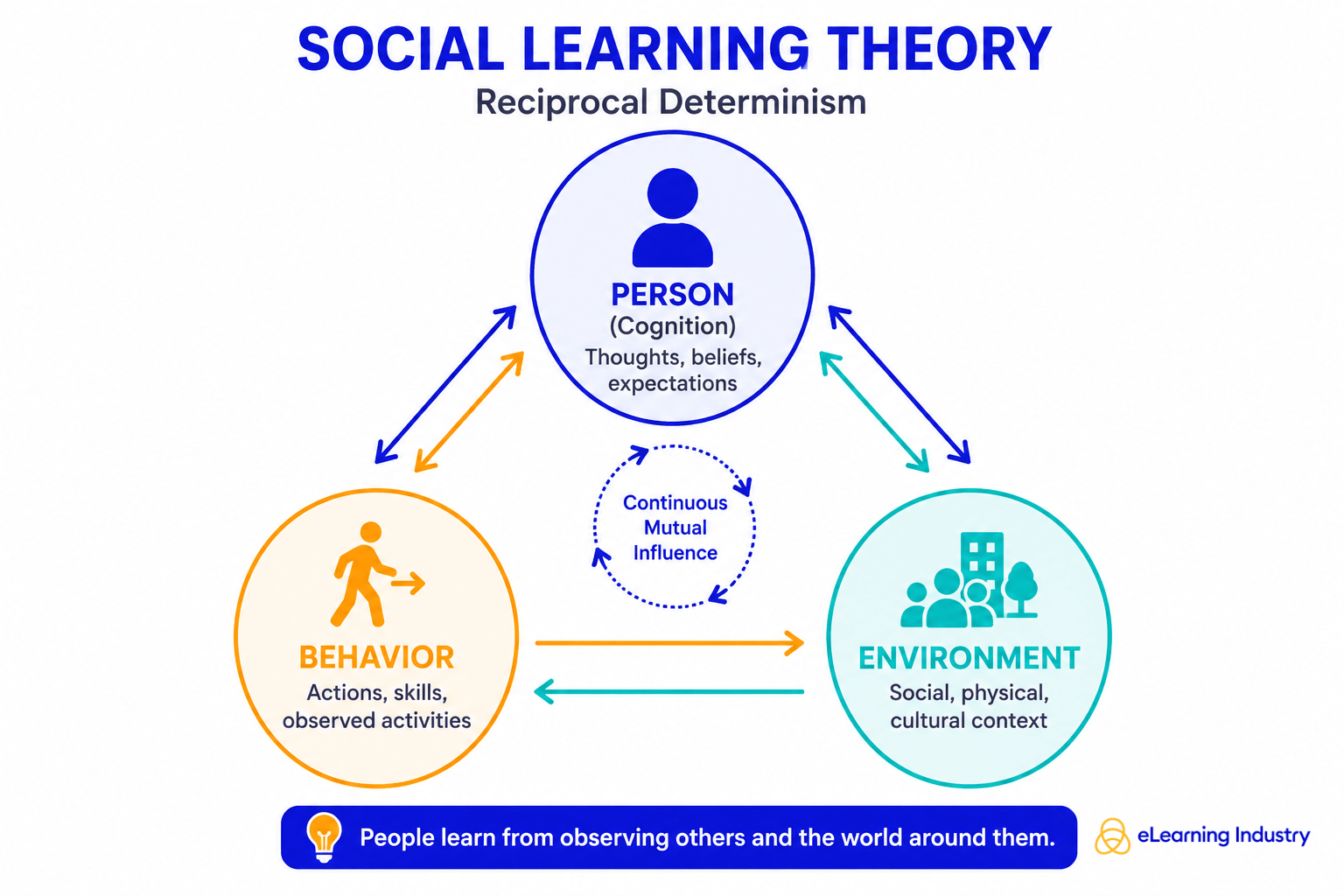
Social Learning Theory Diagram
The social learning theory diagram typically shows a three-way interaction between person, behavior, and environment, known as reciprocal determinism. It illustrates that learning is not one-directional; instead, individuals both influence and are influenced by their surroundings and actions. In workplace or education contexts, the diagram helps visualize how observation, feedback, and social context continuously shape behavior over time.
Social Learning Theory Examples In Real Life And Workplaces
Social learning theory examples can be seen in almost every environment where people observe, interact, and adapt their behavior based on others.
Workplace Learning
In workplace learning, one of the clearest social learning examples is onboarding through shadowing. New employees often learn faster by watching experienced colleagues handle real tasks rather than relying only on formal training.
Leadership modeling behavior is another strong example, where employees observe how managers communicate, make decisions, and handle pressure, and then mirror those behaviors over time. This is a core idea in social learning theory in education and organizational settings, where behavior is shaped through observation as much as instruction.
Education
In education, examples of social learning theory include peer learning and classroom observation. Students frequently learn problem-solving strategies by watching classmates explain answers or work through tasks. Teachers also use group activities so learners can observe different approaches and improve through interaction.
Social Work
In social work and behavioral change, social learning theory applications often involve therapy modeling. For example, therapists may demonstrate coping strategies, communication skills, or emotional regulation techniques that clients then observe and practice. This approach is widely used in behavior modification programs and rehabilitation settings, where seeing positive behavior increases the likelihood of replication.
eLearning
In digital learning environments, social learning theory examples are increasingly visible in LMS discussion boards and collaborative learning platforms. Learners observe how peers respond to questions, share insights, and solve problems. This interaction creates a cycle of observation and imitation, even in virtual spaces. Collaborative tools like forums, cohort-based courses, and shared workspaces also strengthen social learning by making learning visible and interactive.
How Social Learning Theory Applies To L&D And Organizational Strategy
Social learning theory matters for today’s L&D and organizational strategy because most workplace learning happens informally, not just in formal training. Employees usually pick up skills by watching others, copying what works, and adjusting as they go. That’s why Bandura’s social learning theory is so valuable for leaders who want to shape behavior across the organization.
For L&D professionals, one key insight from Albert Bandura’s social learning theory is that learning is a social process. Employees learn not only from courses but also from their peers, managers, and the culture around them. If organizations overlook this informal learning, they miss out on a big part of how people actually learn at work.
This idea has clear effects on how we design learning programs.
- First, designing for peer learning is essential. Setting up structured collaboration, communities of practice, and group projects lets employees watch and learn from each other’s effective behaviors.
- Second, mentoring systems are important. Good mentors show consistent behaviors for others to follow, which is at the heart of observational learning.
- Third, leaders set the example. They shape behavior not just by what they say, but even more by what they do.
This approach can have a big impact on performance. When organizations use social learning theory well, they see real changes in behavior, not just more knowledge. Over time, as people continue to see and practice the right behaviors, these actions become part of the company culture.
In the end, applying social learning theory to education and workplace strategy helps organizations build learning systems that are ongoing, social, and behavior-focused. This leads to better and longer-lasting results.
Conclusion
Social learning theory still matters because most learning today happens through interaction, not just formal instruction. In hybrid workplaces, employees observe peers and leaders across in-person and digital settings, shaping how they work and make decisions. Digital collaboration tools also amplify this effect, making behaviors, habits, and problem-solving approaches more visible and repeatable across teams. In AI-enabled learning environments, people still rely on human modeling, feedback, and shared context to learn effectively. The key takeaway is that learning is socially distributed. It is shaped by environment, relationships, and observation, not just delivered through training programs or modules.